
Congressional Hearings Can Change A Nation
In what were to become known as The Army-McCarthy hearings, the US Senate’s Subcommittee on Investigations wrestled with the chicanery of falsified documents while its forgers lied and hurled nonsense accusations of sexual perversion and radical leftism.
The year was 1954, and I was living in Lincolnwood, Illinois, adjacent to Skokie, in a home built by my father in this mostly Jewish Chicago suburb. My mom’s best friend from high school and her husband lived right across the street. And their son Adam, my first best friend, had been born just about three months before me. My mom Syvia and Adam’s mom Ruth would set up their ironing boards in our basement and watch our 24-inch black & white tv while pressing the families’ laundry. Adam and I shared a playpen in front of them, where they could keep one eye on us, one on the ironing, and one on the tv set. Yes, moms have as many eyes as they need at any given moment.
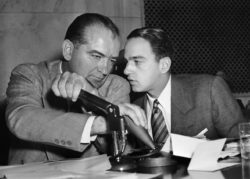
Censured Senator Joseph McCarthy with his counsel, Roy Cohn
Adam and I were one year old. Yet I remember the two moms watching the McCarthy Hearings, along with 80 million other Americans tuning in to ABC’s gavel-to-gavel coverage.
Why, of all the days when I was one year old (There were well over 300 of them!) would this be the one that sticks? Why would this become my very earliest memory? Psychology tells us that life events charged with the strongest emotions are the ones that become our most indelible memories. The horrors of the Nazi holocaust had come to light only ten years prior, and Ruth and Syvia had good reason to watch McCarthy with foreboding and alarm. Even before he discovered the ratings that anticommunism would bring him, McCarthy had come to prominence as a virulent antiSemite and a defender of Nazi war criminals. He was a darling of American antisemites and white supremacists, in particular the Ku Klux Klan.
And he was the chair of the subcommittee. But because the committee was investigating McCarthy’s misdeeds, he was recused, yet given opportunities to speak. Understand that, unlike the January 6 committee, these hearings were a back and forth of competing agendas.
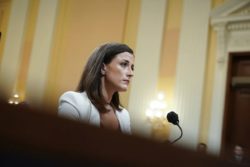
Former White House Aide Cassidy Hutchinson, testifying at the January 5 House Select Committee Hearings
As McCarthy was continuing a barrage of malicious accusations targeting and seeking to destroy the life of a completely innocent young Boston lawyer (who had at one time been a member of a leftist association), Army counsel Joseph Welch famously awakened America when he interrupted McCarthy’s bile: “Let us not assassinate this lad further, Senator; you’ve done enough. Have you no sense of decency, sir? At long last, have you left no sense of decency?” It was a moment of America coming to its senses. McCarthy dug himself deeper into his trench of guilt and indecency and his popularity plummeted.
Sixty-eight years later, we are witness to another set of emotionally charged Congressional hearings. Things have changed. The hearings risk getting lost amongst today’s saturating media and a fragile persistence of truth. And that gushing media atrophies our ability to pay attention while exploitative cable news befuddles national consensus.
But some things haven’t changed. Then as now, outrage is summoned, and outrage best describes the state of political discourse. Then as now, certain officials have been sanctioned or excluded from hearings because they are persons of interest to the committee. Then as now, the committee is presenting facts that reveal the chicanery of falsified documents and perpetrators who lie and hurl nonsense accusations of sexual perversion and radical leftism. The stakes are higher and the media battleground is more fraught, but the emotional charge of the hearings in general and the testimonies of patriots like Cassidy Hutchinson have the power to wake America up just as Joseph Welch did, in this case, to the atrocity of the attempted coup that spawns even greater risks than McCarthyism.

January 14th, 2026 Coming over Highway 17 into Los Gatos, timing the journey so we’d get a perfect spot in Winterland. Timing the trip so the acid would peak midway through the Dead’s show. The bass hits hard on the opening chords of “Sugar Magnolia” and you shouted, “Phil Lesh is a God!” You turned...
You asked me to write about what it is like having a partner with ALS. You want to know what it is like to be in my shoes. As a former Legislative Counsel, I can tell you that, legally, “a” is read as “any.” So, you have actually asked me what it is like having...
Shepherd Siegel died on January 14 after a valiant struggle with ALS, surrounded by family and friends. His partner Susan Leslie accompanied him with love and devotion throughout his illness. She survives him, along with his sisters Adena Siegel (Steve Soklin) and Gretta Siegel, and nephew Leo Stein. Born in Chicago in 1953, the family...